
The 2026 crypto trends defining market structure
The 2026 crypto trends defining market structure are no longer driven by retail speculation, but by institutional capital and algorithmic efficiency. As regulatory frameworks solidify, the market is shedding its speculative skin to integrate with traditional finance. This shift marks a transition from a casino-like environment to one governed by predictive liquidity and on-chain data costs.
Institutional integration is the primary engine of this change. Major exchanges like Coinbase and Kraken report that market intelligence is now dominated by algorithmic trading firms and regulated entities rather than individual day traders. This influx of capital brings stability but also requires a new understanding of how liquidity moves. It is no longer about hype cycles; it is about the mechanics of capital deployment and the cost of data execution.
The emergence of blob-specific dynamics further complicates the landscape. With the introduction of blob data, transaction costs have become a critical factor in network valuation. Algorithms now prioritize chains where data verification is cheaper and faster, creating a bifurcation in network utility. This data-driven approach means that the value of a blockchain is increasingly tied to its ability to process and verify large datasets efficiently, rather than just its transaction throughput.
As we look at the broader macro context, the focus has shifted to how these structural changes impact asset prices. The market is no longer just reacting to news; it is pricing in the long-term viability of on-chain infrastructure. This requires a more nuanced view of market health, one that looks beyond simple price action to the underlying mechanics of liquidity and data flow.
AI Algorithms Capture DEX Liquidity
Artificial intelligence is fundamentally restructuring how liquidity operates on decentralized exchanges. In 2026, the dominant paradigm has shifted from passive market making to predictive liquidity placement. AI trading bots no longer simply provide static quotes; they analyze on-chain data patterns to position capital where volatility is predicted to occur. This shift transforms liquidity from a static resource into a dynamic, responsive asset.
The mechanism relies on sophisticated algorithms that monitor transaction flows, gas prices, and historical volatility spikes. By anticipating sudden influxes of trading volume, AI agents can deploy capital to specific price ranges or pools milliseconds before human traders react. This predictive capability significantly reduces slippage for regular users and tightens spreads across major pairs. The result is a more efficient market where capital is allocated with surgical precision rather than broad distribution.
This evolution is particularly evident in the handling of blob data costs on Ethereum. As Layer 2 solutions and modular chains increasingly utilize blobs for cheap data availability, AI agents must constantly rebalance liquidity across these fragmented venues. The bots automatically detect when blob market volatility creates arbitrage opportunities or liquidity gaps, moving funds to maintain optimal depth. This automated rebalancing prevents the fragmentation that typically plagues multi-chain ecosystems.
The user experience reflects these backend changes. Traders encounter tighter spreads and faster execution speeds, as AI-driven liquidity providers eliminate the idle capital that previously sat unused in less active pools. However, this efficiency comes with a concentration of power. A small number of sophisticated AI models now control the majority of available liquidity, raising questions about market resilience during extreme stress events.
The integration of AI into liquidity provision marks a departure from the open, permissionless ideal of early DeFi. While the efficiency gains are undeniable, the reliance on proprietary algorithms introduces new centralization risks. As these systems become more complex, monitoring their behavior and ensuring fair access to liquidity will remain a critical challenge for the ecosystem.
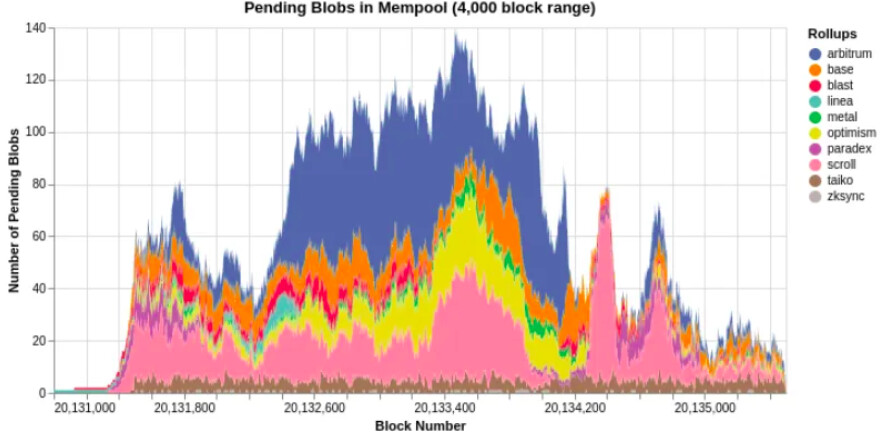
Blob Market Volatility
The implementation of EIP-4844 fundamentally altered the cost structure of onchain data availability, creating a new vector for market volatility. By drastically reducing the price of blob space, Ethereum enabled high-frequency trading strategies that were previously economically unviable. This shift has transitioned data availability from a static infrastructure cost into a dynamic liquidity driver, where the price of blobs directly influences the speed and volume of complex onchain settlements.
Cheaper data availability has facilitated the rise of niche market structures that rely on rapid, granular data posting. High-frequency algorithms now utilize blob space to execute micro-trades and update state channels with minimal latency. This efficiency has increased the velocity of capital but also amplified the correlation between blob gas prices and broader market volatility. When blob demand spikes, it often signals intense speculative activity or the deployment of new liquidity protocols, creating short-term price shocks.
The interaction between blob costs and predictive liquidity models has created a feedback loop. As more capital flows into blob-heavy strategies, the baseline cost of data availability rises, forcing other protocols to compete for space or adjust their execution parameters. This competition can lead to sudden liquidity withdrawals or congestion, impacting the stability of decentralized exchanges and lending markets. The volatility is not merely a function of asset prices but of the underlying data market's capacity to absorb transaction load. This structural shift requires market participants to monitor blob gas metrics alongside traditional technical indicators. The cost of data availability has become a leading indicator for onchain activity intensity. As the blob market matures, its volatility will likely integrate more deeply with broader crypto market cycles, making it a critical component of risk management for institutional players and high-frequency traders alike.
Real-Time Market Commentary
The crypto market in late May 2026 is navigating a complex transition driven by institutional liquidity shifts and the maturation of AI-driven trading mechanisms. Volatility remains a defining feature, but the sources of that volatility have changed. Traditional macro drivers are now intertwined with on-chain data flows, particularly the costs and efficiencies associated with Ethereum blob transactions.
Institutional positioning has become increasingly granular. As noted in Coinbase’s 2026 market outlook, clearer regulation and deeper integration into the core financial system are reshaping how large capital allocators view digital assets. This is not just about holding; it is about integrating crypto into broader portfolio strategies alongside equities and bonds.
Social signals from late May reflect this nuanced environment. Market commentators are closely watching the interplay between traditional equity performance and crypto liquidity. The following tweets capture the immediate sentiment and technical positioning observed on May 20, 2026.
These real-time snapshots highlight a market that is no longer reacting in isolation. The correlation between equity indices like the S&P 500 (/ES) and tech-heavy Nasdaq (/NQ) with crypto assets is tightening. Traders are using this interplay to gauge risk appetite, especially as Federal Reserve minutes and major earnings reports loom. The result is a more efficient, but potentially more fragile, liquidity landscape where AI models must constantly recalibrate to new data inputs.
Community Concerns on Algorithmic Risk
While institutional reports highlight 2026 as a year of transformative growth and clearer regulation, the on-chain reality tells a more complex story. Algorithmic liquidity bots, driven by predictive models and blob data costs, operate at speeds that often outpace human reaction times. This creates a fragile environment where technical optimism meets systemic vulnerability.
The primary risk is not just market volatility, but the mechanics of execution. Flash crashes have become increasingly common as automated strategies react to minor liquidity shifts. For non-technical traders, these events are often indistinguishable from normal market noise until capital is already lost. The learning curve to navigate these automated DEX environments is steep, and many retail participants lack the tools to detect predatory bot behavior.
Regulatory scrutiny is also intensifying. Authorities are beginning to treat these autonomous trading agents as financial instruments, subject to the same oversight as traditional hedge funds. This shift adds compliance costs but may also provide a layer of protection for smaller investors. The challenge lies in enforcing these rules across decentralized networks where jurisdiction is ambiguous.
The convergence of illicit activity and high-frequency trading poses another threat. Recent crime reports indicate that expanded sanctions-related activity often overlaps with market-driven illicit operations. Bad actors can exploit the opacity of algorithmic liquidity to launder funds or manipulate prices, further complicating the landscape for legitimate traders.

No comments yet. Be the first to share your thoughts!