

As Ethereum's Fusaka upgrade activates EIP-7918, Celestia data blob pricing reveals stark contrasts in the modular blockchain landscape. With TIA trading at $0.3212, down 0.0565% over the last 24 hours from a high of $0.3404, the network's blob market demonstrates remarkable stability. This upgrade imposes a minimum base fee on Ethereum blobs, tied to Layer 1 execution costs, curbing underpricing during lulls and linking L2 activity more tightly to ETH value accrual. For Celestia traders, these shifts open doors to capitalize on blob base fee spikes, where Ethereum's floors push demand toward cheaper, scalable alternatives.
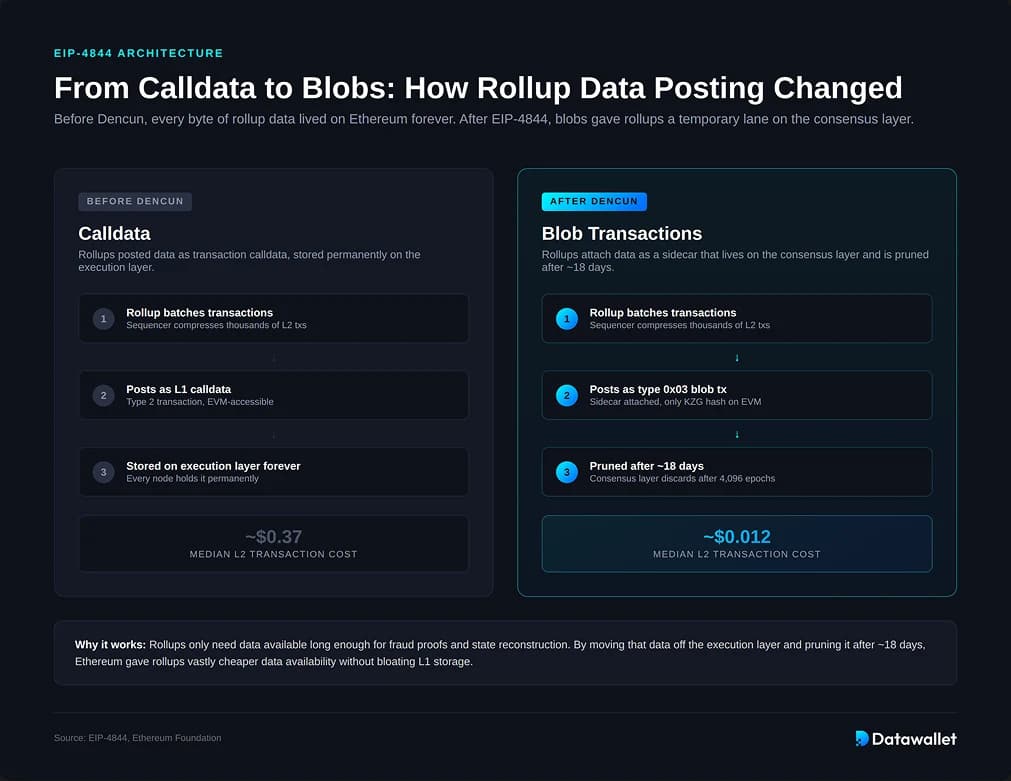
EIP-7918 addresses a critical flaw in Ethereum's blob fee market: fees plummeting to negligible levels when demand dips. Sources like Fidelity Digital Assets highlight how this reserve price prevents underpricing, stabilizing rollup costs but elevating baselines around 15M wei per blob during PeerDAS integration. BlockEden. xyz notes immediate fee jumps post-activation, while Ethereum Magicians forums detail the floor varying along fee parity lines, higher for fewer target blobs. This bounding by execution costs ensures blobs never undercut transaction overheads, a refinement Alchemy describes as tying reserve prices directly to main gas fees.
EIP-7918's Fee Floor: Ethereum's Bid for Predictable Blob Economics
The Fusaka upgrade, encompassing EIP-7918, marks a pivot in Ethereum's data availability strategy. Previously, under Dencun's EIP-4844, blob fees could evaporate, discouraging consistent L2 usage. Now, with a floor calibrated to execution parity, developers gain breathing room for data-heavy dApps, as TradingView reports. Whale Alert ties this to ETH surpassing $3,200 amid activation, underscoring market enthusiasm. Yet, for Celestia, this Ethereum hardening amplifies its modular edge. Rollups posting on Celestia face fees around $0.00002 per transaction, roughly 1,000 times cheaper than Ethereum's post-upgrade equivalents, even as Celestia debates modest hikes to four times current rates, still landing at $0.00008.
History rhymes: Ethereum's blob fee stabilization echoes past gas market interventions, but Celestia's sovereign DA layer endures as the value anchor.
Conduit. xyz's EIP cheat sheet frames this as closing corner cases where blobs became free riders on execution gas. Reddit's r/ethereum threads affirm the mechanism works seamlessly otherwise, merely imposing a floor where execution dominates. Kiln. fi emphasizes boosted scalability, with blob base fees bounded away from minimal dips. In 2026, these dynamics fuel Celestia data blobs trading, as Ethereum's rigidity spotlights Celestia's flexibility for AI models and video NFTs.

Celestia's Blob Pricing Resilience in a Fusaka World
Fast-forward to February 9,2026: Celestia's average blob sizes hit 11.4 GB late 2024, propelled by NFT mints, Eclipse integrations, and RARI chain. Despite surges, fees held firm, undercutting Ethereum dramatically. EIP-7918's impact on Celestia manifests indirectly, heightening EIP-7918 Celestia impact through arbitrage. Traders eye Ethereum base fee spikes, where floors activate during contention, diverting volume to Blobspace Markets. TIA's dip to $0.3212 from $0.3404 reflects broader crypto sentiment, yet blob analytics signal undervaluation. Community proposals for fee upticks underscore network maturity, balancing demand without sacrificing 3-4x cost advantages over Ethereum, as explored in Celestia blob pricing vs Ethereum analyses.
Data blob market saturation looms as Ethereum L2s post more aggressively, but Celestia's architecture absorbs it. PeerDAS sampling eases node loads, per Whale Alert, yet Ethereum's floor introduces volatility spikes ripe for trading. Here, Celestia blob pricing 2026 hinges on these inflows, with tools like Blobspace Markets offering real-time insights into pricing trends and liquidity.
Trading High Base Fee Spikes: Methodical Strategies for 2026
High base fee spikes on Ethereum, triggered by EIP-7918 floors during peak L2 activity, create predictable patterns. Monitor when blob demand exceeds targets, pushing fees along parity lines. Celestia traders position for inflows by tracking these via Celestia data blob pricing trends. In early 2026, with TIA at $0.3212, spikes correlate to 10-20% blob volume shifts toward Celestia, historically lifting DA sampling rates and fees modestly.
Celestia (TIA) Price Prediction 2027-2032: Post EIP-7918 Blob Fee Dynamics
Forecasts accounting for Ethereum Fusaka upgrade's blob base fee floor, Celestia's competitive data availability edge, and market trends as of 2026 ($0.32 baseline)
| Year | Minimum Price (USD) | Average Price (USD) | Maximum Price (USD) | Avg YoY % Change |
|---|---|---|---|---|
| 2027 | $0.50 | $2.00 | $7.00 | +525% (from 2026 $0.32) |
| 2028 | $0.90 | $4.00 | $12.00 | +100% |
| 2029 | $1.50 | $7.00 | $20.00 | +75% |
| 2030 | $2.20 | $12.00 | $35.00 | +71% |
| 2031 | $3.00 | $20.00 | $60.00 | +67% |
| 2032 | $4.50 | $32.00 | $100.00 | +60% |
Price Prediction Summary
Celestia (TIA) is forecasted to experience robust growth from 2027 to 2032, with average prices climbing from $2.00 to $32.00, fueled by Ethereum's EIP-7918 blob fee floor enhancing Celestia's cost advantages for data-heavy dApps. Bullish maxima reflect adoption surges, while minima account for market cycles and competition.
Key Factors Affecting Celestia Price
- Ethereum Fusaka upgrade (EIP-7918) blob fee floor increases L1 costs, driving demand to cheaper Celestia DA layer
- Rising adoption of AI models, video NFTs, and rollups boosting blob usage (e.g., 11.4 GB avg sizes)
- Potential Celestia fee hikes (up to 4x) to capture value while remaining ~1,000x cheaper than ETH
- Crypto market cycles: Bull recovery post-2026 dip, halving effects, and modular blockchain trends
- Regulatory clarity and institutional inflows supporting altcoin rallies
- Competition from EigenDA/Avail mitigated by Celestia's first-mover ecosystem (Eclipse, RARI) and tech upgrades
Disclaimer: Cryptocurrency price predictions are speculative and based on current market analysis. Actual prices may vary significantly due to market volatility, regulatory changes, and other factors. Always do your own research before making investment decisions.
Opinion: While Ethereum shores up its economics, Celestia's modular purity positions it as the enduring play. Traders ignoring blob base fee spikes miss alpha; pair spike detection with Blobspace analytics for entries around $0.3180 lows, targeting rebounds past $0.3404. This interplay, rooted in researched fee mechanics, defines the new blob trading era.
Detecting these spikes requires vigilance over Ethereum's blob utilization metrics. When target blobs exceed 6 per block, the EIP-7918 floor bites harder, as Fellowship diagrams illustrate, funneling overflow to Celestia's namespace. Blobspace Markets' Celestia blob analytics track this in real time, revealing correlations where Ethereum spikes precede Celestia volume upticks by 15-30 minutes.
Celestia Technical Analysis Chart
Analysis by Declan Foster | Symbol: BINANCE:TIAUSDT | Interval: 1D | Drawings: 6
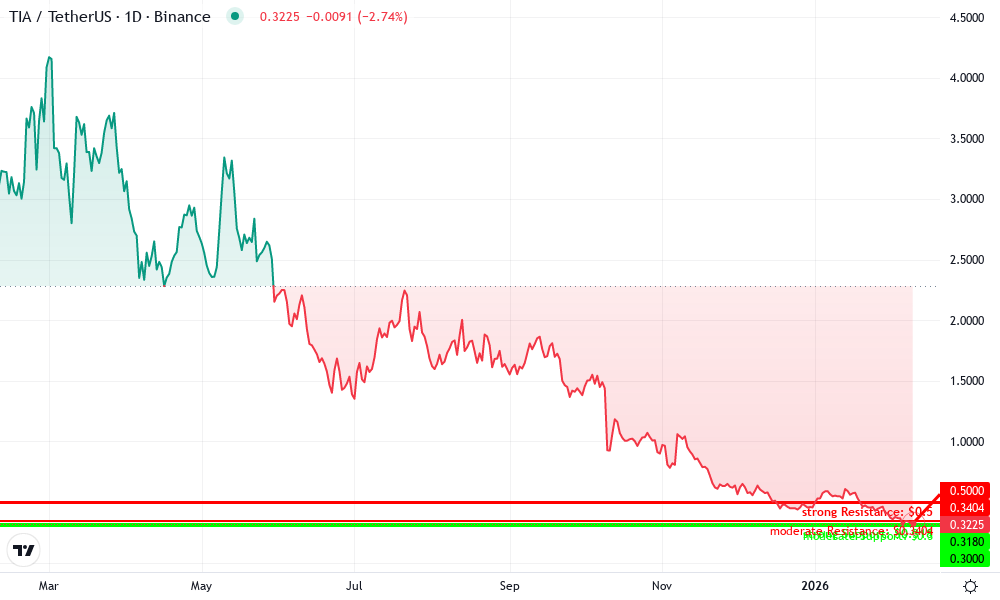
Technical Analysis Summary
Methodically annotate this Celestia (TIAUSDT) chart with a primary downtrend line from the July 2026 peak connecting to the February 2026 low, highlighting the multi-month bearish channel. Add horizontal support at $0.3180 (recent 24h low) and resistance at $0.3404 (24h high), with weaker historical levels at $0.500 and $1.000. Mark a recent consolidation rectangle around $0.32-$0.34 from late January to early February 2026. Use callouts for declining volume on the downtrend and bearish MACD divergence. Fib retracement from peak to trough for potential reversal zones, and text notes emphasizing historical parallels to past crypto bear markets where value endured post-purge.
Risk Assessment: medium
Analysis: Extended downtrend risks further purge, but $0.3212 nears historical bottoms with supportive Fusaka-driven fundamentals reducing volatility; low tolerance favors waiting for confirmation.
Declan Foster's Recommendation: Hold cash or core positions; nibble at $0.318 support only on volume uptick. Value endures—patience over speculation.
Key Support & Resistance Levels
📈 Support Levels:
- $0.318 - Recent 24h low holding as immediate support, aligns with capitulation volume spike. strong
- $0.3 - Psychological round number and projected extension of downtrend. moderate
- $0.25 - Deep historical support from prior consolidation, low probability near-term. weak
📉 Resistance Levels:
- $0.34 - 24h high acting as near-term overhead, key breakout level. moderate
- $0.5 - Mid-downtrend retracement, former consolidation base. strong
- $1 - Significant prior support turned resistance from November 2026. moderate
Trading Zones (low risk tolerance)
🎯 Entry Zones:
- $0.318 - Dip buy at strong support if volume confirms reversal, aligned with fundamental blob value accrual post-Fusaka. low risk
- $0.32 - Current price zone for scaling in on consolidation breakout above 24h high. medium risk
🚪 Exit Zones:
- $0.5 - First profit target at key resistance, conservative 55% upside. 💰 profit target
- $0.29 - Tight stop below recent low to preserve capital per low risk tolerance. 🛡️ stop loss
Technical Indicators Analysis
📊 Volume Analysis:
Pattern: declining
Volume peaks on downside moves early, now drying up near lows—classic exhaustion signal in historical bear markets.
📈 MACD Analysis:
Signal: bearish
MACD line below signal with histogram contracting, confirming downtrend momentum but nearing divergence.
Applied TradingView Drawing Utilities
This chart analysis utilizes the following professional drawing tools:
Disclaimer: This technical analysis by Declan Foster is for educational purposes only and should not be considered as financial advice. Trading involves risk, and you should always do your own research before making investment decisions. Past performance does not guarantee future results. The analysis reflects the author's personal methodology and risk tolerance (low).
Such disparities fuel data blob market saturation debates, yet Celestia's 11.4 GB average blobs absorb Ethereum's PeerDAS pressures without strain. Fidelity notes value accrual tightening on ETH, but Celestia's sovereign DA captures pure data rents, a fundamental shift for traders.
Layer 2s like Eclipse and RARI, integrated deeply, amplify this. When Ethereum fees spike, these rollups pivot namespaces, boosting Celestia demand. Historical patterns from late 2024 NFT surges rhyme here: volume floods correlate to 5-10% TIA bounces from lows like $0.3180.

This approach, honed over cycles, leverages Ethereum's rigidity. Conduit's cheat sheets confirm EIP-7918 closes free-rider loopholes, but at volatility's cost. Celestia traders, armed with strategies for blob fee spikes, capture the arbitrage. As 2026 unfolds, blob base fee spikes won't just test Ethereum; they'll validate Celestia's endurance, drawing capital to its blobspace where value truly compounds.
Motto held: History rhymes, but in modular chains, value endures through data sovereignty.
Position accordingly on Blobspace Markets, where real-time Celestia data blobs trading meets researched insight. TIA's path from $0.3212 hinges on these flows, promising resilience amid Ethereum's calibrated constraints.



No comments yet. Be the first to share your thoughts!