

As Celestia solidifies its role as the premier data availability layer in modular blockchains, its data blob market reveals a tale of robust fundamentals clashing with short-term token pressures. On February 3,2026, Celestia processes an average of 26 GB in daily data postings, dwarfing Ethereum's 2.5 GB and underscoring a migration fueled by cost efficiencies and scalability. Yet, the TIA token trades at $0.3680, down 0.0182% over the last 24 hours with a high of $0.3793 and low of $0.3666. This disconnect highlights why Blobspace Markets tools are essential for dissecting Celestia data blob pricing beyond surface-level price action.
Blobspace Expansion: From 225 Daily Fees to Rollup Dominance
Celestia's blobspace has ballooned since late 2024, when blob fees scraped just $225 per day. Fast-forward to now, and daily postings hit 26 GB, propelled by surging transaction volumes and NFT frenzies. This isn't mere hype; it's a structural shift. Rollups, seeking affordable data availability, have flocked to Celestia, now anchoring 26 of them. The 'Fibre' upgrade promises 1 terabit-per-second throughput with minimal latency, positioning Celestia to capture even more demand in the ZK and modular ecosystems.
Consider the revenue angle: blob fees, the lifeblood of Celestia's economics, have scaled dramatically. Sources like Blockworks analytics dashboards break it down into blob-specific fees for data availability versus standard transaction costs. This growth isn't accidental; it's the result of Celestia's modular design separating data availability from execution and consensus, as outlined in foundational primers from Cumulo. pro.
With the increase in data posted on Celestia, the chain has also seen growth in blob fee revenue.
Traders eyeing Celestia blobspace trends 2026 should note how this expansion correlates with TIA's muted performance. While the token dips, blob volumes signal underlying strength, a classic divergence worth monitoring on platforms like Blobspace Markets.
Cost Leadership: Celestia's Edge Over Ethereum Blobs
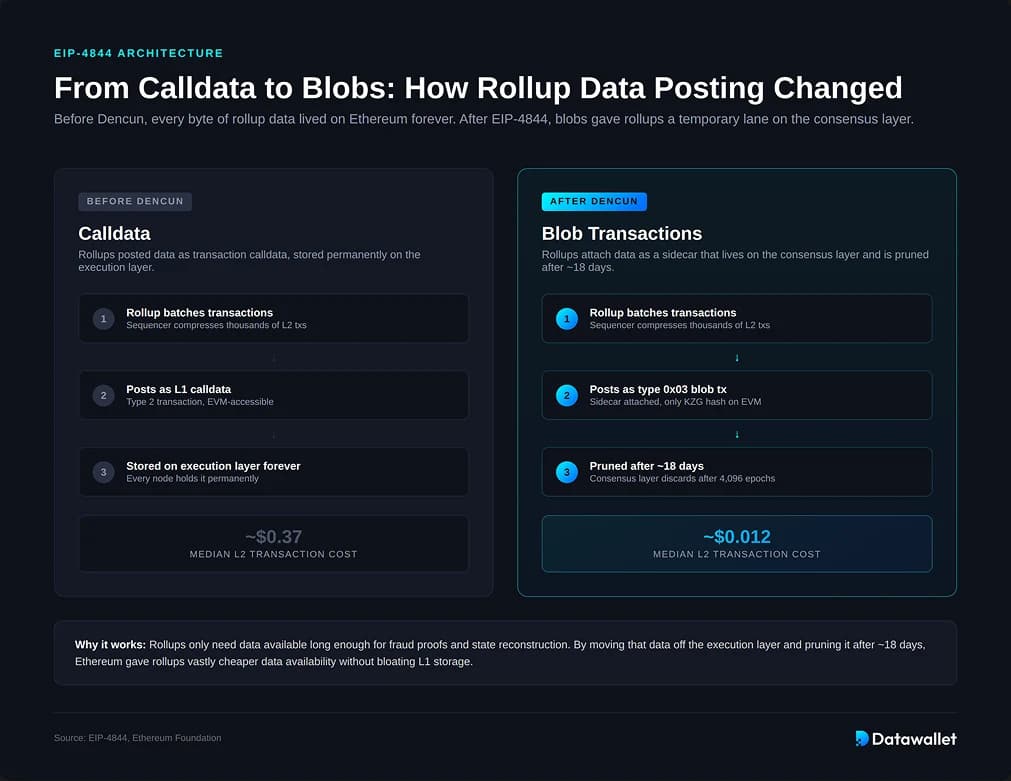
Price sensitivity rules data availability markets, and Celestia delivers. Data costs have plunged from $0.30 per mebibyte in November 2024 to around $0.07 today, making it 64% cheaper than Ethereum's $20.56 per MB over comparable periods, per Conduit analysis. Rollups prepaying quotas still settle at spot prices, ensuring market-driven efficiency without forward commitments, as debated on the Celestia Forum.
This affordability drives adoption. Charts from The Block illustrate daily blob sizes in GB, showing Celestia's lead. Binance reports confirm recent spikes in blob count and volume, aligning with ChainCatcher's observations. For traders, this translates to predictable fee structures amid volatility; lower costs mean higher throughput tolerance, buffering against spikes.
Yet, opinion: Ethereum's blob constraints expose its limits in a data-hungry world. Celestia's model, enhanced by innovations like LazyBridging and CLOBs discussed in Alchemy's deep dives, offers a scalable alternative. Learn more on how to analyze Celestia data blob pricing trends on Blobspace Markets.
Decoding Blob Fee Signals for 2026 Trading
Blob trading signals emerge from fee dynamics and volume trends. Spot pricing within quotas keeps markets liquid, but surges in daily GB postings foreshadow fee pressure. At 26 GB versus Ethereum's 2.5 GB, Celestia absorbs demand without proportional cost hikes, a bullish indicator for sustained revenue.
Quantitative screens reveal patterns: 10x fee growth from 2024 baselines, per BlockEden, pairs with TIA's consolidation at $0.3680. Selling pressure persists, with a weekly drop noted amid broader market jitters, but blob metrics suggest accumulation opportunities. Blobspace Markets' analytics empower users to track these via real-time dashboards, blending pricing trends with volume data for data blob market analysis.
Forward-looking, the Fibre upgrade and rollup influx point to compressed margins initially, then expansion. Traders should watch blob-per-transaction ratios; elevations signal network stress and potential fee rebounds. For precise entry points, consider these projections grounded in current trajectories.
Celestia (TIA) Price Prediction 2027-2032
Forecasts incorporating data blob growth, Fibre upgrade, rollup adoption, and modular blockchain trends amid market cycles
| Year | Minimum Price | Average Price | Maximum Price |
|---|---|---|---|
| 2027 | $0.42 | $1.15 | $3.80 |
| 2028 | $0.75 | $2.40 | $7.20 |
| 2029 | $1.40 | $4.80 | $13.50 |
| 2030 | $2.20 | $7.50 | $22.00 |
| 2031 | $3.50 | $11.80 | $35.00 |
| 2032 | $5.50 | $18.50 | $52.00 |
Price Prediction Summary
Celestia (TIA) is projected to see robust long-term growth from 2027-2032, driven by exploding blob usage, cost efficiencies, and the Fibre upgrade boosting throughput to 1 Tbps. Average prices could climb from $1.15 to $18.50, with max potentials up to $52 amid bull markets and rollup expansion to potentially 100+. Mins reflect bearish risks from Ethereum competition, regulations, and cycles, starting conservatively from current $0.37 levels.
Key Factors Affecting Celestia Price
- Surge in blob sizes to 26 GB/day (vs Ethereum 2.5 GB), driving fee revenue
- Data costs down to $0.07/MB, enhancing competitiveness
- Fibre upgrade for ultra-high throughput and low latency
- Growing rollup adoption (26+ currently, more expected)
- Crypto market cycles with potential 2028 bull run
- Regulatory clarity for DA layers and modular chains
- Risks from selling pressure and Ethereum blob improvements
Disclaimer: Cryptocurrency price predictions are speculative and based on current market analysis. Actual prices may vary significantly due to market volatility, regulatory changes, and other factors. Always do your own research before making investment decisions.
These projections hinge on blob growth sustaining above 26 GB daily, with Fibre unlocking terabit-scale capacity to handle ZK rollup surges. Yet, at $0.3680, TIA's 10.68% weekly slide reflects broader crypto headwinds, not protocol weaknesses. Savvy traders decouple token noise from blob fundamentals using Blobspace Markets tools for granular data blob market analysis.
Spotting Inflection Points: Volume Spikes and Fee Rebounds
Blob trading signals sharpen when volumes spike without fee explosions. Recent ChainCatcher data via Binance flags doubled blob counts over two weeks, yet costs hold at $0.07 per mebibyte. This resilience stems from prepaid quotas settling at spot, avoiding locked-in premiums as Celestia Forum research clarifies. Watch for divergences: if daily GB climbs past 30 while TIA lingers near $0.3666 lows, it screams undervaluation.
Opinion: Celestia's edge sharpens in high-throughput scenarios. Ethereum's blobs choke at scale; Celestia thrives, as Alchemy breakdowns on LazyBridging show. Clobs on blobs herald decentralized order books atop cheap DA, amplifying utility. Traders ignoring this miss the modular pivot reshaping 2026 Celestia blobspace trends 2026.
Celestia vs Ethereum Blobs: 2026 Current Data
| Network | Daily Volume (GB) | Cost per MB (USD) | Rollups Served |
|---|---|---|---|
| Celestia | 26 | $0.07 | 26 |
| Ethereum | 2.5 | N/A | N/A |
Cross-chain comparisons underscore Celestia's dominance. At 26 GB daily versus Ethereum's 2.5 GB, revenue potential scales linearly, yet TIA discounts it at $0.3680. Bankless charts tie this to NFT booms and rollup migrations; 26 active rollups today could double by mid-year post-Fibre.
Balanced Portfolio Plays: Managing Volatility in Blob Markets
Blob trading signals demand discipline. Quantitative screens flag buy zones when blob fees dip below $0.10 per MB amid volume upticks, signaling capacity buffers. Pair this with TIA's 24-hour range of $0.3666 to $0.3793; breakouts above $0.38 could target prior highs if blob revenue 10x's again.
Risks loom, though. Network stress from unchecked growth might spike fees, pressuring low-margin rollups. Selling pressure persists, but Blobspace Markets dashboards quantify this via blob-per-transaction metrics. Forward contracts? Absent in spot-only quotas, but implied pricing emerges from volume forecasts. Diversify: allocate 10-15% to TIA amid blob longs, hedging with stablecoin yields.
Practical execution favors platforms dissecting these layers. Track how blob fee spikes impact Celestia data blob traders; sudden jumps erode edges but create mean-reversion trades. Cumulo primers remind us: Celestia's DA purity sidesteps monolithic bloat, fueling 2026 upside.
Envision 2026: 50 and GB daily postings, fees stabilizing at $0.05-0.10, TIA reclaiming $1 and as adoption compounds. Blobspace Markets equips you to navigate this, blending real-time pricing with predictive analytics. Fundamentals win; position accordingly.



No comments yet. Be the first to share your thoughts!