
How to Analyze Celestia Data Blob Pricing Trends with Celenium Explorer

In the rapidly evolving Celestia ecosystem, mastering Celestia data blobs pricing trends is essential for anyone eyeing opportunities in blobspace trading. With Celestia (TIA) trading at $0.3339, up $0.002950 or and 0.8910% over the last 24 hours, recent surges in blob sizes and transaction volumes underscore the network’s growing appeal. Average blob sizes have ballooned tenfold to 11.4 GB, fueled by events like the Mammoth Overlord NFT mint and adoption by projects such as Eclipse, while daily transactions climbed 60% to 71,000. Yet, Celestia’s fees remain sharply competitive against Ethereum’s, positioning it as a cost-effective data availability layer. Enter the Celenium explorer, a powerful tool that democratizes Celestia block analysis and Celestia blob pricing insights right in your browser.

This isn’t just about watching numbers tick; it’s about discerning patterns that signal sustainable growth in the blobspace. Celenium’s real-time analytics on blob sizes, transaction volumes, and fee structures cut through the noise, enabling precise Celestia block analysis. As a CFA charterholder who’s navigated countless market cycles, I view these tools as force multipliers for disciplined traders, much like candlestick charts were to early stock analysts.
Decoding the Forces Shaping Celestia Blob Pricing
Celestia data blobs represent the backbone of modular blockchain scalability, posting transaction data for rollups without the execution burden. Pricing here hinges on supply-demand dynamics within each blockspace. Demand spikes, as seen recently with NFT mints and rollup integrations, drive up Celestia blob pricing, but Celestia’s design caps costs efficiently. Data shows Celestia blobs are 10x larger yet 50x cheaper than Ethereum’s, with full-period costs at $7.31 per MB versus Ethereum’s heftier tabs. Daily blob fees have rocketed nearly 10x from late 2024’s $225, reflecting explosive adoption.
Celestia Runs a Light Node in User’s Browser When Using Celenium Explorer, enhancing accessibility for all users.
Key drivers include namespace competition, where blobs vie for space, and gas fees that incentivize efficient packing. Celenium shines by visualizing these: track per-blob costs, occupancy rates, and fee velocity. With TIA at $0.3339, even modest blob fee upticks translate to meaningful network revenue, bolstering long-term value accrual.
Navigating Celenium Explorer for Blob Insights
Launch Celenium. io, and you’re greeted with a intuitive dashboard for Celestia block analysis. Connect your wallet optionally to run a light node in-browser, peering directly into the network without heavy infrastructure. Search transactions, addresses, blocks, namespaces, or blobs effortlessly. The terminal button unlocks advanced queries, ideal for submitting test blobs or probing gas mechanics.
- Head to the Blobs tab for a chronological feed of recent submissions, noting sizes and fees.
- Dive into Blocks view to gauge space utilization; high occupancy signals rising Celestia blob pricing.
- Use the Analytics section for charts on trends – blob volume, average size, and fee per MB over time.
This setup empowers developers and traders alike. For instance, amid the recent 11.4 GB average blob surge, Celenium users spotted fee stability early, a telltale of resilient demand elasticity.
Essential Metrics for Informed Blobspace Trading
To trade blobspace profitably, prioritize these Celenium-derived metrics. First, blob size distribution: larger averages, like the current 11.4 GB, indicate heavy rollup usage but watch for congestion premiums. Second, fee percentiles: the 90th percentile fee hints at peak pricing pressure. Third, transaction throughput at 71,000 daily underscores capacity, yet namespaces with chronic undersupply warrant scrutiny.
Celestia (TIA) Price Prediction 2027-2032
Forecasts amid surging data blob adoption, competitive DA pricing, and rollup ecosystem growth (Baseline 2026 Avg: $0.40)
| Year | Minimum Price | Average Price | Maximum Price | YoY % Change (Avg) |
|---|---|---|---|---|
| 2027 | $0.45 | $0.70 | $1.20 | +75% |
| 2028 | $0.75 | $1.10 | $2.00 | +57% |
| 2029 | $1.20 | $1.80 | $3.20 | +64% |
| 2030 | $1.80 | $2.80 | $5.00 | +56% |
| 2031 | $2.80 | $4.20 | $7.50 | +50% |
| 2032 | $4.20 | $6.50 | $12.00 | +55% |
Price Prediction Summary
Celestia (TIA) shows strong bullish potential from $0.33 current levels, driven by 10x blob size surges, 60% transaction growth, and cost advantages over Ethereum. Average prices projected to rise progressively to $6.50 by 2032 in base case, with max scenarios reflecting bull market peaks amid DA dominance.
Key Factors Affecting Celestia Price
- Surging blob sizes (11.4 GB avg) and transaction volumes (71k daily) boosting network revenue
- 64% cheaper DA costs vs Ethereum, attracting rollups like Eclipse
- Celenium Explorer enabling real-time analytics for informed trading
- Crypto market cycles favoring modular DA layers in bull phases
- Technological upgrades and LazyBridging enhancing scalability
- Regulatory clarity on DA and competition from ETH blobs
- Macro adoption trends in rollups and NFTs driving demand
Disclaimer: Cryptocurrency price predictions are speculative and based on current market analysis.
Actual prices may vary significantly due to market volatility, regulatory changes, and other factors.
Always do your own research before making investment decisions.
Layer in velocity – fees divided by TIA market cap at $0.3339 – for revenue quality. High velocity with stable prices suggests undervaluation. Celenium’s filters let you isolate high-fee namespaces, prime for blobspace trading strategies like arbitrage across rollups. I’ve seen traders net edges by front-running mint events, using these signals to position ahead of volume spikes.
Gas fees, dissected via Celenium’s guides, reveal more: pay-for-priority mechanics ensure fairness, unlike Ethereum’s volatility. This predictability is gold for portfolio managers balancing risk in crypto’s wilds.
Spotting these patterns requires hands-on practice, and that’s where Celenium’s interface truly excels in delivering actionable Celestia block analysis.
Celestia Technical Analysis Chart
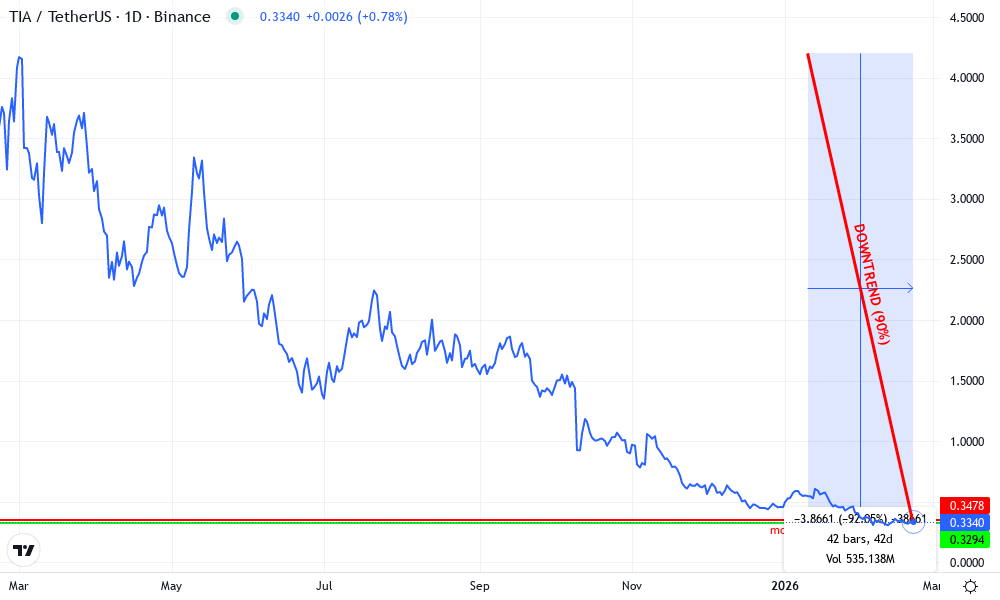
Analysis by Ethan Carmichael | Symbol: BINANCE:TIAUSDT | Interval: 1D | Drawings: 6
Technical Analysis Summary
As Ethan Carmichael, my conservative technical analysis on this Celestia (TIAUSDT) daily chart emphasizes disciplined risk management amid a pronounced bearish structure. Begin by drawing a primary downtrend line (trend_line) connecting the swing high at approximately $4.20 on 2026-01-05 to the recent low near $0.3294 on 2026-02-19, extending to current levels around $0.3339—this captures the dominant multi-month decline with high confidence. Add horizontal lines (horizontal_line) at key support $0.3294 (24h low) and resistance $0.3478 (24h high), plus a stronger resistance at $0.50 from prior consolidation. Apply Fibonacci retracement (fib_retracement) from the $4.20 high to $0.3294 low, highlighting 23.6% ($0.85), 38.2% ($1.35), and 50% ($2.26) levels for potential pullback targets, though unlikely without volume confirmation. Mark the recent consolidation range (rectangle) from 2026-02-10 ($0.50) to 2026-02-21 ($0.3339). Use callouts (callout) on declining volume bars and MACD bearish crossover. Place an arrow_mark_down at the MACD signal line cross below zero around 2026-02-01. Vertical line (vertical_line) at 2026-02-15 for blob surge news impact. RSI oversold near 30 warrants a text note for caution, not entry. All drawings prioritize clean, educational visuals supporting a wait-and-see stance.
Risk Assessment: high
Analysis: Dominant downtrend, oversold conditions without reversal signals, high volatility in crypto DA sector
Ethan Carmichael’s Recommendation: Stand aside for now; monitor for bullish structure confirmation before low-risk long allocation (1% portfolio max). Fundamentals support holding core position long-term.
Key Support & Resistance Levels
📈 Support Levels:
-
$0.329 – 24h low and recent swing low, potential oversold bounce point
moderate -
$0.3 – Psychological round number and extension of decline
weak
📉 Resistance Levels:
-
$0.348 – 24h high, immediate overhead barrier
moderate -
$0.5 – Prior consolidation low turned resistance
strong
Trading Zones (low risk tolerance)
🎯 Entry Zones:
-
$0.35 – Break above 24h high with volume confirmation, aligning with fib 23.6% retrace
low risk -
$0.85 – Deeper fib retracement with MACD bullish cross
mediumBegin by filtering for recent blocks with elevated blob activity, such as those post-Mammoth Overlord mint. Cross-reference size spikes against fee hikes; if costs hold steady below Ethereum’s $7.31 per MB benchmark despite 11.4 GB averages, it flags robust scalability. Next, map namespace trends: oversubscribed ones command premiums, ideal for blobspace trading entries. Finally, project forward using velocity metrics – current daily fees, up nearly 10x from 2024 levels, paired with 71,000 transactions, suggest TIA’s $0.3339 price undervalues network utility.
Celestia Technical Analysis Chart
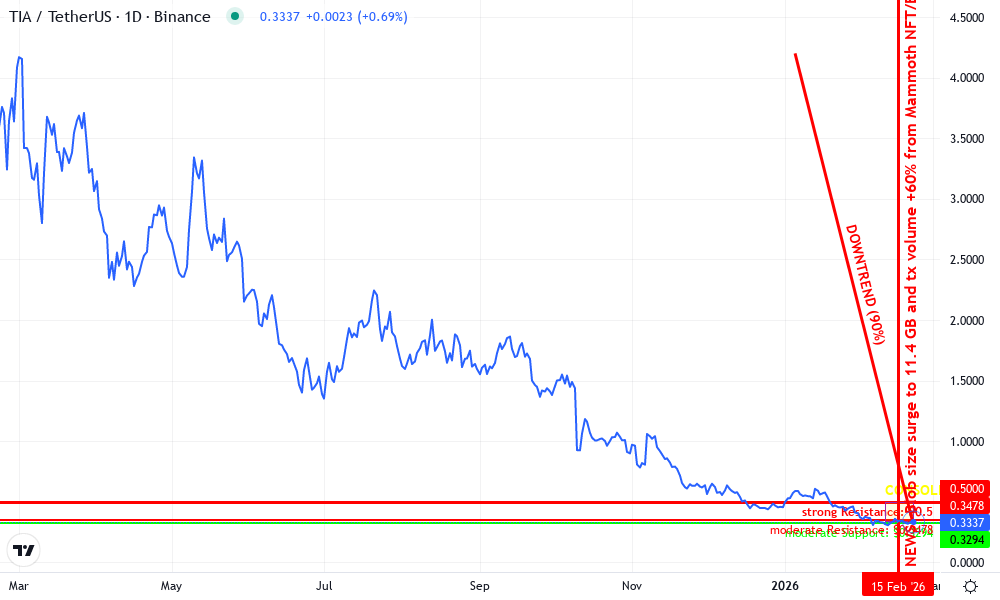
Analysis by Ethan Carmichael | Symbol: BINANCE:TIAUSDT | Interval: 1D | Drawings: 4
Technical Analysis Summary
As Ethan Carmichael, apply conservative technical markings to highlight the dominant bearish structure while emphasizing risk-managed levels aligned with current market data at $0.3339. 1. Draw a primary downtrend line (trend_line) connecting the swing high at $4.20 on 2026-01-10 to the recent low near $0.34 on 2026-02-21, extending forward conservatively. 2. Add horizontal lines (horizontal_line) for support at $0.3294 (label ‘Moderate Support – 24h Low’) and resistance at $0.3478 (label ‘Moderate Resistance – 24h High’). 3. Apply Fib retracement (fib_retracement) from the major high $4.20 to low $0.3294, highlighting 23.6% ($0.92), 38.2% ($1.38), and 50% ($2.26) levels for potential reversals. 4. Mark recent consolidation as a date_price_range from 2026-02-10 to 2026-02-21 between $0.33-$0.50. 5. Use callouts (callout) on volume spikes during breakdowns (e.g., mid-January decline) noting ‘Bearish Volume Confirmation’. 6. Arrow mark down (arrow_mark_down) on MACD for bearish signal near recent candles. 7. Text annotations for key insights like ‘Capitulation Zone – Watch Fundamentals’. Avoid aggressive position markers given low risk tolerance.
Risk Assessment: high
Analysis: Technical bear trend dominates despite strong blob adoption fundamentals; volatility high near $0.3339 lows, broken supports increase downside risk
Ethan Carmichael’s Recommendation: Hold cash or existing positions with stops; no new longs until close above $0.35 + MACD flip. Prioritize risk management over speculation.
Key Support & Resistance Levels
📈 Support Levels:
-
$0.329 – 24h low and chart recent bottom, potential fundamental support if blob growth sustains
moderate -
$0.3 – Psychological round number and extension of downtrend support
weak
📉 Resistance Levels:
-
$0.348 – 24h high, initial resistance to any bounce
moderate -
$0.4 – Prior minor swing low now resistance, Fib 23.6% nearby
weak
Trading Zones (low risk tolerance)
🎯 Entry Zones:
-
$0.332 – Near current $0.3339 support cluster with positive blob news; conservative dip-buy only on volume confirmation
low risk
🚪 Exit Zones:
-
$0.3 – Tight stop loss below 24h low to protect capital per low risk tolerance
🛡️ stop loss -
$0.36 – Modest profit target at resistance for 8-10% gain, aligning conservative style
💰 profit target
Technical Indicators Analysis
📊 Volume Analysis:
Pattern: Elevated spikes on downside breaks, drying up recently
Confirms distribution phase but potential exhaustion near $0.3339 lows
📈 MACD Analysis:
Signal: Bearish below zero line
No bullish crossover; divergence possible with funda strength
Applied TradingView Drawing Utilities
This chart analysis utilizes the following professional drawing tools:
Trend LineHorizontal LineFib RetracementDate Price RangeCalloutArrow Mark DownTextDisclaimer: This technical analysis by Ethan Carmichael is for educational purposes only and should not be considered as financial advice.
Trading involves risk, and you should always do your own research before making investment decisions.
Past performance does not guarantee future results. The analysis reflects the author’s personal methodology and risk tolerance (low).Video breakdowns like this reinforce the mechanics: gas ensures equitable access, with fees scaling predictably to demand. In my experience managing digital asset portfolios, ignoring these subtleties leads to mistimed trades; embracing them, however, uncovers alpha in quieter namespaces.
Consider a real-world pivot. During Eclipse’s integration, Celenium users noted blob sizes swelling without proportional fee jumps. Traders who positioned long TIA at levels near today’s $0.3339 capitalized as revenue accrued, validating disciplined Celestia blob pricing analysis.

Advanced Strategies and Risk Calibration
Beyond basics, layer in comparative analysis. Pit Celestia’s metrics against Ethereum blobs: 10x size capacity at 50x lower cost isn’t hype, it’s a structural moat. Celenium’s block explorer lets you quantify this edge, tracking rollup migrations that swell volumes. For blobspace trading, arbitrage low-fee windows – submit during lulls, or speculate on high-demand namespaces via TIA exposure.
- Entry Signal: Occupancy above 80% with stable fees signals impending Celestia blob pricing uptick.
- Exit Signal: Fee velocity peaking relative to TIA’s $0.3339 market cap hints at overextension.
- Hedge: Pair with Ethereum DA shorts if Celestia dominance grows.
Risk management anchors everything. Celestia’s light node feature in Celenium mitigates oracle risks by letting you verify data client-side. Set alerts for transaction drops below 71,000 daily, a potential demand fade. Diversify across namespaces to dodge event-specific volatility, like NFT mint exhaustions. My motto holds: sustainable growth demands this rigor, turning blob trends into portfolio stabilizers amid crypto turbulence.
With Celestia (TIA) holding at $0.3339 after a 0.8910% 24-hour gain, the blob surge narrative strengthens. Developers flock to its cheap, scalable DA layer; traders glean edges from Celenium’s precision tools. Whether probing gas dynamics or forecasting via analytics, the Celenium explorer equips you to navigate Celestia data blobs markets with clarity and confidence, positioning for the modular future.
-
$0.329 – 24h low and chart recent bottom, potential fundamental support if blob growth sustains