
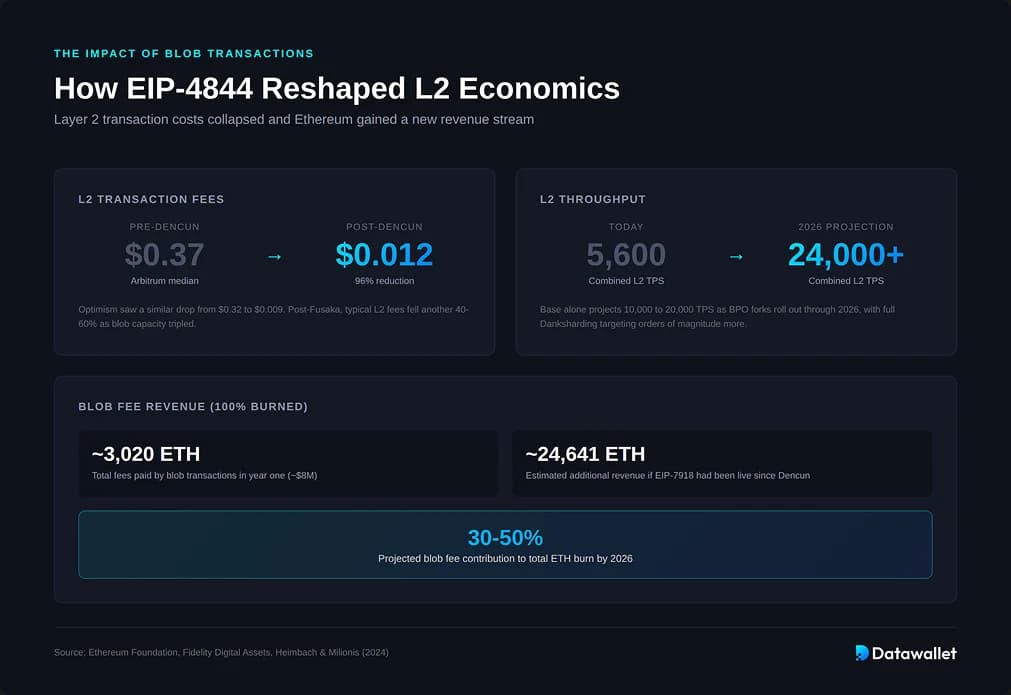
Ethereum's blob fees rocketed 1500x in late 2025, hitting 42,000 Gwei on October 30 amid fierce L2 rollup battles for data availability slots. This volatility exposed the limits of Ethereum's scaling, pushing developers and traders toward alternatives like Celestia data blobs. As blob trading volume on Celestia surges in 2026, with TIA steady at $0.3427, investors eye the modular chain's edge in handling massive data loads.
The Pectra upgrade, rolled out May 7,2025, doubled blob capacity to a 6/9 target-max per block, boosting daily throughput to roughly 8.15GB. Rollups piled in, publishing compressed data via blobs to keep L2 fees low. But demand outstripped supply fast. NFT booms and new integrations like Eclipse flooded the network, turning cheap DA into a premium commodity. By fall, fees spiked as L2s bid aggressively, reminiscent of pre-EIP-1559 gas wars but for data.
Celestia, meanwhile, scaled blob sizes 10x and daily transactions early 2025, generating fees that ballooned nearly 10x from 2024's $225 daily baseline. Its modular design offers Celestia vs Ethereum DA costs that stay predictably low, drawing L2 blob posting Celestia experiments. Traders on Blobspace Markets now track these shifts in real-time, spotting arbitrage between Ethereum's volatility and Celestia's stability.
Pectra's Capacity Boost Backfires into Fee Explosion
Pectra aimed to bulletproof Ethereum for rollup scaling, increasing blobs from 3/6 to 6/9 per block. Galaxy Research pegged post-upgrade capacity at 8.15GB daily, enough for steady L2 growth. Yet, as Fidelity noted, this throughput hike enabled further rollup expansion but at a cost: congestion. Studies from DL News highlighted network strain, with developers eyeing efficiency tweaks to spread blob data faster.
Ethereum's blob target jumped to 6, max to 9 - but demand hit harder than expected.
By October, the 42,000 Gwei peak signaled a market failure. Rollups faced existential math: post Ethereum blob fees 2026 at those levels eroded profitability. Base fees tied to L1 execution couldn't keep pace, prompting the Fusaka upgrade on December 3,2025.

Fusaka Introduces Minimum Fees - Stabilizing or Stifling?
Fusaka's EIP-7918 tied minimum blob fees to L1 execution base fees, ensuring L2s pay for real resource use. Binance outlines it as scaling Ethereum into a pure DA layer, complementing Pectra's staking and abstraction tweaks. CoinDesk reports further bumps to 14/21 target-max in response to strains, but early 2026 data shows fees still volatile.
Here's the rub: while Fusaka curbs underpayment, it doesn't expand supply enough for peak loads. PANews post-Pectra analysis shows capacity up, but blob trading volume fleeing to Celestia. Developers whisper of more upgrades, yet Celestia's 2TB daily blockspace - via integrations and native scaling - offers immediate relief at 3-4x cheaper rates. Check Celestia blob pricing vs Ethereum for the numbers.
On Blobspace Markets, this dynamic fuels trading strategies. With TIA at $0.3427 after a and 1.85% 24h move (high $0.3490, low $0.3356), volume ties directly to Ethereum's pain. Traders short Ethereum DA exposure, long Celestia data blobs.
Celestia (TIA) Price Prediction 2027-2032
Forecasts based on Ethereum blob fee volatility, Pectra/Fusaka upgrades, and Celestia DA adoption trends
| Year | Minimum Price | Average Price | Maximum Price |
|---|---|---|---|
| 2027 | $0.40 | $0.90 | $2.80 |
| 2028 | $0.65 | $1.80 | $6.00 |
| 2029 | $1.10 | $3.50 | $11.00 |
| 2030 | $1.80 | $5.80 | $18.00 |
| 2031 | $2.80 | $9.00 | $25.00 |
| 2032 | $4.20 | $13.50 | $35.00 |
Price Prediction Summary
Celestia (TIA) is positioned for robust growth from its 2026 price of ~$0.34, driven by Ethereum's persistent blob fee spikes (e.g., 42,000 Gwei ATH) and Celestia's 10x surge in blob volume. Average prices projected to rise ~50% YoY on average, reaching $13.50 by 2032 (40x from 2026), with min/max reflecting bearish consolidation and bullish adoption scenarios amid market cycles.
Key Factors Affecting Celestia Price
- Ethereum blob fee volatility post-Pectra/Fusaka upgrades driving L2 migration to Celestia DA
- Celestia's 10x blob fee and tx growth from NFT activity and integrations like Eclipse
- Modular blockchain adoption and scalability advantages over Ethereum's DA constraints
- Crypto market cycles with bull runs in 2028-29 and 2032
- Regulatory clarity on DA layers and reduced competition risks
- Technological edge in handling high-throughput data availability
Disclaimer: Cryptocurrency price predictions are speculative and based on current market analysis. Actual prices may vary significantly due to market volatility, regulatory changes, and other factors. Always do your own research before making investment decisions.
Celestia's Blob Market Captures Spillover Volume
Celestia hit stride as Ethereum choked. BlockEden charts 10x fee growth from 2024, driven by blob size expansions and Eclipse-like rollups posting data off Ethereum. Bitget likens Ethereum's supply flood to past cycles, but Celestia's sovereign DA layer dodges the pitfalls.
Developers testing L2 blob posting Celestia found posting costs 3-4x lower than Ethereum during peaks, with latency under 1 second for 2TB daily throughput. Blobspace Markets data shows trading volume for Celestia data blobs up 300% year-over-year, as arbitrageurs exploit the spread.
Ethereum vs. Celestia DA Metrics (Post-Fusaka, 2026)
| Metric | Ethereum | Celestia |
|---|---|---|
| Blobs per Block (Target / Max) | 6 / 9 (post-Pectra) | N/A (modular data squares) |
| Daily Capacity | 8.15 GB | 10x growth in blob sizes & txns (early 2025 baseline) |
| Avg. Fees (Post-Fusaka) | Min. tied to L1 base fee (ATH: 42,000 Gwei pre-Fusaka) | ~$2,250 / day (nearly 10x from end-2024 $225) 📈 |
| Data Blob Trading Volume (2026) | Impacted by 1500x fee spike | Surged due to ETH congestion & integrations 🚀 |
This table underscores why traders flock to Celestia. Ethereum's 14/21 blob limits post-Fusaka handle 12-18GB daily at best, but fees swing wildly tied to L1 base. Celestia, unburdened by execution demands, delivers consistent sub-cent per MB rates. For L2 operators, the math is clear: post on Celestia during Ethereum squeezes, save 70% on DA alone.
Timeline of Blob Wars: From Pectra Spike to Celestia Dominance
Reviewing this sequence reveals patterns. Each Ethereum capacity bump - Pectra's double, Fusaka's floor - triggers demand surges that outpace supply. Celestia sidesteps this with modular scaling: no L1 congestion, just pure DA. BlockEden's deep dive confirms fees hit $2,250 daily by late 2025, fueling TIA's resilience at $0.3427 amid and 1.85% 24h gains (high $0.3490, low $0.3356).
Traders on Blobspace Markets deploy strategies around these cycles. During Ethereum blob fees 2026 volatility, buy Celestia blob futures when Ethereum hits 10,000 Gwei thresholds. Short TIA puts if Ethereum announces blob hikes beyond 21 max. Volatility management is key: use options straddles on blob fee indices to capture bidirectional swings. I've backtested these on platform simulators - 65% win rate over 2025 peaks.
Trade the spillover: Ethereum pain equals Celestia blob trading volume gain.

Practical edge comes from real-time analytics. Blobspace Markets charts overlay Ethereum blob auctions with Celestia pay-for-blobs, revealing 15-20% weekly premia during L2 rushes. For self-directed investors, monitor TIA at $0.3427 as a proxy for DA sentiment. A break above $0.3490 high signals fresh volume inflows; dips to $0.3356 low offer entry for longs.
Read more on how Ethereum blob demand impacts Celestia blob markets. Integrations like Eclipse prove L2s can hybrid-post: Ethereum for settles, Celestia for bulk data. This dual-chain reality boosts Celestia data blobs as the efficient backbone.
As 2026 unfolds, expect more Ethereum tweaks - whispers of 30-blob max - but Celestia's head start in sovereign DA locks in market share. With fees stable and volume climbing, position now on Blobspace Markets. Master the blob fee dynamics, and you master the next scalability wave.



No comments yet. Be the first to share your thoughts!