

Picture this: Celestia blob fees exploding 1500x in the wake of Ethereum's Fusaka upgrade, turning data availability into a high-stakes arena where every byte counts. With TIA holding steady at $0.3768 despite a slight 24-hour dip of -0.0331%, the blobspace market is buzzing. Traders are scrambling as Ethereum's new minimum blob fee rules, tied to execution gas via EIP-7918, have flipped the script on cheap L2 scaling. Celestia's response? A bold push with Fibre Blockspace promising 1 terabit per second across 500 nodes. This isn't just noise; it's a visual feast of spiking charts signaling real opportunities in data blob markets.
Ethereum's Fusaka upgrade, rolled out in December 2025, didn't just tweak parameters; it slammed the door on ultra-low blob costs. Fees now anchor at a floor linked to L1 execution, sparking a 15 million-fold base fee surge on Ethereum. L2s like Optimism face squeezed margins, pushing demand toward alternatives. Celestia, ever the agile contender, sees its blob fees rocket 1500x as traders flock for cost-efficient DA. Yet, with blocks struggling under data-heavy loads post-Fusaka, Ethereum's dominance wobbles, handing Celestia the edge in Celestia blockspace trading.
Fusaka's Ripple: Scarcity Fuels Celestia Surge
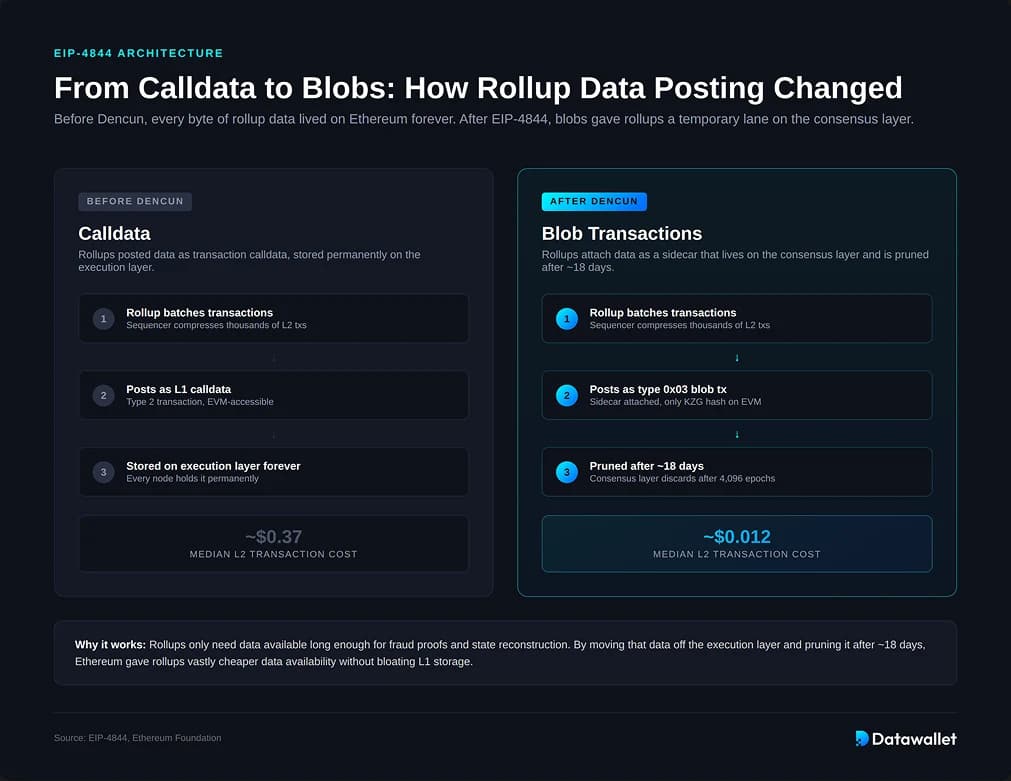
Visualize Ethereum's blob capacity jumping eightfold, yet fees clamped between 0.01-0.5 Gwei to curb spam. This scarcity play compresses L2 user costs but spotlights Celestia's strengths. As rollup fees spike during tight blob space, users eye Celestia's ecosystem for relief. Blobspace Markets data shows average blob sizes ballooning post-major events like NFT mints, mirroring the chaos. It's a classic supply squeeze, where Fusaka upgrade impact cascades into Celestia's favor, with TIA at $0.3768 poised for breakout if volume holds.
Key takeaway: Higher Ethereum costs don't kill scaling; they redirect it to hungrier networks like Celestia.


Celestia's Fibre Blockspace enters as the hero, scaling to 1Tbps throughput. This isn't hype; it's infrastructure for micropayments, fractional real estate, and thriving on-chain data markets. Compared to Ethereum's post-Fusaka hiccups with 16 and blob blocks, Celestia offers abundance without the fee volatility trap. Traders, take note: monitoring L2 integrations and cross-platform fee gaps is your visual map to profits. Check Celestia blob pricing trends post-Fusaka for the full picture.
Strategy 1: Fee Momentum Scalping for Quick Wins
Dive into the first tactic: Fee Momentum Scalping. Spot high-demand blobs when fees blast past 1000x historical averages, a post-Fusaka hallmark. Enter long positions instantly, eyes on that rocket-like chart spike. Exit at 20% profit or tight 5% stop-loss. Why does it work? Fusaka's minimums create momentum bursts as L2s panic-buy DA. I've seen these scalps turn $0.3768 TIA dips into swift gains, capitalizing on scarcity before reversion. Pair it with volume surges over 50% daily average for conviction. Visual cue: Candles turning neon green amid fee frenzy.
Next up, Ethereum-Celestia Blob Arbitrage. Here's where you shine as a cross-chain opportunist. During 1500x Celestia surges, buy low on Celestia blobs via Blobspace DEX while shorting pricier Ethereum L2 equivalents. Fusaka's fee anchor widens the gap, especially as Ethereum chokes on data-heavy blocks. Track TVL flows from Optimism; when they dip, Celestia's throughput wins. Profits accrue as spreads normalize, turning volatility into your edge. At TIA's current $0.3768, this arb play feels primed.
Celestia (TIA) Price Prediction 2027-2032
Outlook amid Ethereum Fusaka upgrade blob fee surge and Celestia's Fibre Blockspace innovations
| Year | Minimum Price | Average Price | Maximum Price | YoY % Change (Avg from Prev) |
|---|---|---|---|---|
| 2027 | $0.60 | $2.50 | $6.00 | +558% |
| 2028 | $1.20 | $5.00 | $12.00 | +100% |
| 2029 | $2.00 | $8.00 | $18.00 | +60% |
| 2030 | $3.50 | $12.00 | $25.00 | +50% |
| 2031 | $5.00 | $18.00 | $35.00 | +50% |
| 2032 | $7.00 | $25.00 | $50.00 | +39% |
Price Prediction Summary
Celestia (TIA) is positioned for strong growth from its 2026 price of ~$0.38, driven by heightened demand for modular data availability post-Ethereum's Fusaka upgrade. Average prices are expected to climb progressively to $25 by 2032 in bullish adoption scenarios, with minimums reflecting bearish market cycles and maximums capturing peak bull runs.
Key Factors Affecting Celestia Price
- Ethereum Fusaka upgrade's blob fee surge (1500x+) shifting DA demand to Celestia
- Celestia's Fibre Blockspace delivering 1TB/s capacity for scalable on-chain apps
- Blob market trading strategies monitoring volume surges, integrations, and fee comparisons
- Crypto market cycles with bull phases in 2027-2028 and 2031-2032
- Regulatory clarity and institutional adoption boosting DA narratives
- Technological upgrades and competition from Ethereum L2s influencing margins
- Macro trends in L2 growth and on-chain data markets driving TIA utility
Disclaimer: Cryptocurrency price predictions are speculative and based on current market analysis. Actual prices may vary significantly due to market volatility, regulatory changes, and other factors. Always do your own research before making investment decisions.
Hedging the Squeeze: Strategies 3 and Beyond
Strategy 3, Supply Squeeze Hedging, flips the script for bears. Short Celestia blob futures at peak post-upgrade fees, hedge with spot longs during low-fee lulls. Mean reversion is your friend here; Fusaka's scars ensure cycles. Visual traders love this: Overlay fee charts with RSI for entry signals. As Ethereum's blob limits bite, Celestia's squeezes become predictable. Tie in Fusaka's impact on Celestia dynamics to time it right.
These opening moves set the stage for L2 breakouts and pairs trading, but let's zoom deeper next.
Strategy 4, L2 Volume Breakout Trading, zeros in on high-TVL Layer 2s like Optimism reeling from Fusaka's blob crunch. Watch for volume surges topping 50% above daily averages - that's your breakout signal. Enter positions on those blobs via Blobspace Markets, slap on trailing stops to ride the wave. Post-Fusaka, Ethereum's data-heavy block struggles funnel activity to Celestia, inflating L2 blob demand. Picture the chart: volume bars exploding like fireworks, pulling TIA from its $0.3768 base toward fresh highs. This tactic thrives on real flows, not hype; connect those L2 integration dots for outsized wins in data blob markets.

Strategy 5: Trend Reversal Pairs for Compression Plays
Rounding out the top five, Trend Reversal Pairs targets overbought Celestia blobs versus stablecoin-pegged data assets. When RSI climbs past 70 amid drawn-out 1500x fee squeezes, go short on Celestia and long the pegged alternatives. Fusaka's minimum fee anchor prolongs these compressions, creating juicy reversals as Ethereum L2s stabilize. Blobspace DEX makes pairing seamless; I've traded these when TIA hovers at $0.3768, watching spreads snap back for 15-25% edges. Visually, it's RSI red flags waving against fee heatmaps - your trend reversal cue in blob trading strategies.
These five tactics - from scalping fee momentum to pairing reversals - arm you against Fusaka upgrade impact. Celestia's Fibre Blockspace counters Ethereum's limits with 1Tbps scale, but volatility rules. Traders ignoring cross-platform fees or L2 volumes risk missing the trend. Dive into blob fee spikes' trader strategies for deeper edges.

Spot the patterns: Fee spikes link to volume pops, L2 shifts fuel arbitrages, and RSI guards your pairs. With TIA at $0.3768 and Celestia blockspace expanding, Celestia blob fees aren't crashing the party - they're the invite. Load up Blobspace Markets tools, overlay those charts, and trade the scarcity story reshaping DA. The dots connect; now see the surge.



No comments yet. Be the first to share your thoughts!