

Picture this: Ethereum's Fusaka upgrade drops like a meteor into the data availability world, and Celestia's blobspace erupts in a 7000x pricing frenzy. Traders who caught the wave early turned modest positions into windfalls, but now, as dust settles, Celestia TIA hovers at $0.5911, up 3.65% in the last 24 hours with a high of $0.5943 and low of $0.5479. What fueled that explosive Celestia blob pricing surge, and what does it mean for blobspace markets 2025? Let's connect the dots from chaos to opportunity.
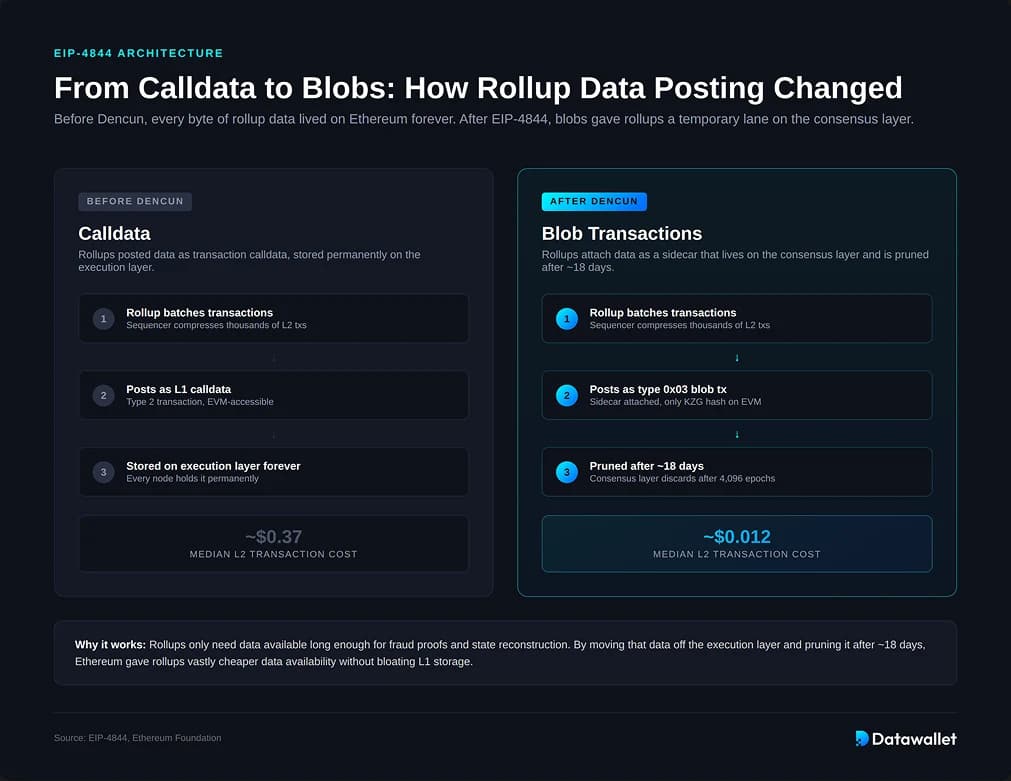
Fusaka didn't just tweak Ethereum's engine; it supercharged blob capacity via PeerDAS and slapped on a minimum base fee through EIP-7918. Suddenly, Ethereum blobs weren't the bargain basement anymore, pushing L2s to eye alternatives like Celestia for cheaper data posting. Celestia, already 64% more affordable at $7.31 per MB versus Ethereum's $20.56, saw demand skyrocket. Blockspace auctions turned fierce, with fees spiking 7000x in peak moments as rollups scrambled for capacity.
Fusaka's Hidden Hand in Blob Fee Explosions
Before Fusaka, post-Dencun blob fees languished near zero, starving networks of meaningful revenue. Enter Fusaka: higher throughput, guaranteed ETH burns, and a wake-up call for modular chains. Celestia responded swiftly with its own bounded base fees, making costs predictable for devs building data-hungry apps. This wasn't just tech talk; it was a market signal. Fusaka's capacity bump initially spooked some into thinking Celestia demand would dip, but history paints a sharper picture.
Visualize the charts: blob fees that idled at fractions of a cent exploded as L2s like based rollups demanded more metadata. Fidelity nailed it - greater data usage equals surging revenue. Traders monitoring blob fee trends Celestia spotted the inflection point early, piling in as Celestia hit 2TB daily blockspace, rivaling Visa-scale volumes post-Lotus upgrade.
Greater Data Usage: Based rollups require more metadata than single sequenced Layer 2s, increasing blob consumption and associated revenue. - Fidelity Digital Assets
Decoding the 7000x Surge Mechanics
That 7000x surge wasn't random noise; it was supply-demand physics in hyperdrive. Pre-Fusaka, low Ethereum blob costs kept Celestia as a niche play. Post-upgrade, Ethereum's expansion created short-term bottlenecks elsewhere, funneling traffic to Celestia's efficient sampling. Fees rocketed from near-zero to peaks that made early adopters rich, but bounded fees capped the madness, drawing in risk-averse traders.
Here's the visual breakdown: imagine a timeline where Fusaka activates, Ethereum ETH jumps 9%, and Celestia blob auctions light up. By October 2025, Celestia data blobs trading volumes swelled, with TIA dipping to $1.39 before rebounding. Now at $0.5911, it's consolidating, but the surge left scars - and scars mean stories for Celestia blob analytics.
- Trigger 1: Ethereum's min blob fee forces L2s to optimize, favoring Celestia's 64% cost edge.
- Trigger 2: Lotus upgrade doubles Celestia throughput, handling 1GB blocks effortlessly.
- Trigger 3: Devs flock for predictable economics, spiking auction competition.
Opinion: this wasn't hype; it was inevitable. Ethereum scales, but modularity wins wars. Traders ignoring Celestia's edge risk missing the next leg up.
Zoom into the numbers. Conduit's data underscores why: while Ethereum blobs hit $20.56/MB, Celestia delivers at $7.31. Post-Fusaka, that gap widened during surges, creating arbitrage goldmines. Yet, with TIA at $0.5911 and a modest and $0.0208 daily gain, the market whispers stability amid volatility.
Celestia (TIA) Price Prediction 2026-2031: Post-Fusaka Blobspace Trends
Forecasts incorporating Ethereum Fusaka upgrade impacts, L2 adoption, blob fee dynamics, and Celestia's cost advantages (64% cheaper than Ethereum blobs)
| Year | Minimum Price | Average Price | Maximum Price | YoY % Change (Avg from Prior) |
|---|---|---|---|---|
| 2026 | $0.45 | $1.20 | $3.50 | +103% |
| 2027 | $0.80 | $2.50 | $6.00 | +108% |
| 2028 | $1.50 | $5.00 | $12.00 | +100% |
| 2029 | $2.50 | $8.00 | $18.00 | +60% |
| 2030 | $4.00 | $12.00 | $25.00 | +50% |
| 2031 | $6.00 | $18.00 | $35.00 | +50% |
Price Prediction Summary
Post-Fusaka, Celestia (TIA) is forecasted for strong growth from current $0.59 levels, driven by L2 data demand, blobspace pricing advantages, and network upgrades like Lotus. Average prices projected to rise progressively from $1.20 in 2026 to $18.00 by 2031 (~30x potential), with min/max reflecting bearish dips and bullish surges amid market cycles.
Key Factors Affecting Celestia Price
- L2 rollup adoption boosting blob demand despite Ethereum capacity expansion
- Celestia's 64% cost edge over Ethereum blobs ($7.31/MB vs $20.56/MB)
- Bounded base fees (EIP-7918) and throughput doublings via Lotus upgrade
- Fusaka-induced volatility creating trading opportunities
- Crypto market cycles, regulatory clarity, and modular DA competition
- Institutional interest in scalable data availability solutions
Disclaimer: Cryptocurrency price predictions are speculative and based on current market analysis. Actual prices may vary significantly due to market volatility, regulatory changes, and other factors. Always do your own research before making investment decisions.
Trader Playbook: Spotting Post-Surge Signals
As we hit December 8,2025, eyes are on adaptation speed. Will L2s stick with Ethereum's pricier blobs, or double down on Celestia? I've seen cycles like this before - post-upgrade dips precede bulls. Monitor Celestia blob pricing trends; a break above $0.5943 high could signal round two.
Blobspace markets 2025 thrive on these nuances. With Celestia eyeing Visa-level tx volumes, the 7000x wasn't a fluke - it was a preview. Position for the interplay: Ethereum's security meets Celestia's speed.
That synergy is where savvy traders shine. Celestia's modular design isn't just cheaper - it's nimbler, absorbing Fusaka's shockwaves while Ethereum grapples with its own success. Picture L2s as shoppers in a crowded mall: Ethereum's aisles widen, but Celestia's express lane stays 64% less congested at $7.31 per MB. As blob fee trends Celestia stabilize, watch for renewed auctions when data demand spikes again.
Metrics That Matter: Tracking Blobspace Momentum
Numbers don't lie, but they need context to sing. Right now, with TIA at $0.5911 after a $0.0208 daily bump and 3.65% gain, blobspace auctions show resilience. Post-Fusaka, Celestia's bounded fees kicked in, preventing endless spirals while Ethereum's minimums guaranteed burns. This balance lured devs posting gigabytes daily, pushing blockspace to 2TB peaks.
For Celestia blob analytics, focus on these signals: daily blob volumes, fee velocity, and L2 migration rates. Conduit's breakdown reveals the edge - Ethereum's $20.56/MB feels the pinch as rollups optimize. My take? Celestia's Lotus upgrade, slashing block times and doubling throughput, positions it for Visa-like scale without the bloat. Traders sleeping on this miss the modularity meta.
Celestia vs Ethereum Blob Costs Post-Fusaka
| Metric | Celestia (TIA) | Ethereum (ETH) | Notes |
|---|---|---|---|
| Blob Cost per MB | $7.31 | $20.56 | Celestia 64% cheaper 💰 |
| Historical Peak Surge | 7000x | N/A | Post-Fusaka pricing peaks |
| Current Price | $0.5911 | N/A | As of Dec 8, 2025 |
| 24h High | $0.5943 | N/A | 📈 |
| 24h Low | $0.5479 | N/A | 📉 |
| 24h Change | +3.65% | N/A | From previous close |
Layer that with real-time tools on Blobspace Markets. Spot when fees creep above base levels - that's your entry for Celestia data blobs trading. I've traded these edges; the 7000x wasn't luck, it was watching supply choke under demand. Now, as Ethereum's PeerDAS ramps, Celestia counters with 1GB blocks, creating a duopoly where winners arbitrage the spread.
Risks and Edges: Navigating 2025 Blob Volatility
Volatility? It's the trader's fuel. Fusaka sparked a 9% ETH jump pre-launch, but Celestia's response was fiercer. Yet dips like TIA's September $1.39 hover remind us: upgrades breed uncertainty. L2s might cling to Ethereum's security, narrowing Celestia's window. Counter that with hedges - pair TIA longs with blob fee shorts during lulls.
Opinion time: Celestia isn't competing head-on; it's redefining the game. While Ethereum burns ETH via EIP-7918 minimums, Celestia accrues value through raw efficiency. Monitor adaptation: if based rollups post more metadata here, fees rebound fast. At $0.5911, with a 24-hour low of $0.5479 and high of $0.5943, we're at a pivot. Break $0.5943, and blob fee spikes could ignite another multi-x run.
Visualize the flow: Fusaka expands Ethereum capacity, easing short-term pressure but highlighting Celestia's cost lead. Devs gain predictability, traders gain signals. Blobspace Markets arms you with charts tracking every auction - from near-zero Dencun days to 7000x frenzy.
- Edge 1: Use bounded fees for tight stops; no more zero-fee traps.
- Edge 2: Track 2TB daily volumes - Visa parity means institutional inflows.
- Edge 3: Arbitrage ETH-Celestia spreads; 64% cheaper draws volume.
Forward gaze: as 2025 unfolds, blobspace markets 2025 evolve into a data superpower. Celestia's pricing, battle-tested by Fusaka, offers traders a canvas of trends. Connect these dots early - the next surge waits for those watching. Dive into Blobspace Markets for live Celestia blob pricing, and trade the trends that matter.



No comments yet. Be the first to share your thoughts!