

Ethereum's Fusaka upgrade activated on December 3,2025, reshaping blob fee dynamics with Peer Data Availability Sampling (PeerDAS) and phased blob capacity expansions. Target blobs per block hold at 6 for now, scaling to 10 by December 17 and 14 by January 7,2026. This targets the volatility that plagued blobs post-Pectra, where fees spiked to 42,000 Gwei on October 30 amid high demand. For Celestia observers tracking Celestia blob pricing 2025, the upgrade signals potential pressure on alternative DA layers, yet Celestia's edge in handling massive data payloads persists.
Celestia's TIA trades at $0.5819 today, up $0.0131 or and 0.0230% over 24 hours, with a high of $0.5891 and low of $0.5672. This modest gain unfolds against Ethereum's push for blob fee stability, which could siphon demand from modular DA providers. Pre-Fusaka, Ethereum's low base fees post-Dencun and Pectra eroded L1 revenue, flipping the network from deflationary to mildly inflationary. Fusaka counters this by linking blob base fees to L1 base fees, imposing a floor to prevent near-zero pricing during lulls.
Fusaka's Mechanism for Fee Stability
The core fix lies in EIP-7918 and related tweaks, curbing unpredictable surges while ensuring blobs contribute meaningfully to Ethereum's economics. Analysts note this reserve pricing model dodges the subsidy trap, where blobs cost pennies during gas price drops. Post-upgrade, expect average fees to drop 50-70% long-term as capacity ramps, per phased increases from 6/9 to 14/21 blobs per block. Yet early reports vary: one claim cites a 15 million-fold blob base fee jump, likely an outlier tied to initial calibration. Reality check: L2 fees stay contained, no wild spikes for users.
Fusaka isn't just capacity; it's value accrual for Ethereum, potentially compressing L2 margins but solidifying its DA dominance. (Adapted from Fidelity Digital Assets)
For traders, this predictability aids options pricing on blob futures. Volatility management sharpens here: stable Ethereum fees mean Celestia must compete on throughput, not just cost. Celestia's average blob sizes ballooned tenfold in late 2024, drawing data-heavy projects Ethereum can't match efficiently yet.
Pre-Fusaka Volatility: Spikes and Celestia's Resilience
Before Fusaka, Pectra's blob doublings slashed fees, but demand surges triggered chaos. October 30's 42,000 Gwei peak hammered L2 costs, pushing rollups toward alternatives like Celestia. Ethereum blobs hit unsustainable lows otherwise, subsidizing usage at L1's expense. Celestia thrived amid this: its flexible blockspace absorbed overflow, with data blob markets showing robust liquidity.
Read how Ethereum's prior limits shaped Celestia blob trading. Traders hedged via Celestia options, capturing premia from Ethereum's fee whiplash. My take: Celestia's modular design buffered it, posting steady Celestia blockspace trends even as Ethereum faltered.
| Period | Ethereum Blob Fee | Celestia TIA Price |
|---|---|---|
| Pre-Pectra | High volatility | Stable growth |
| Post-Pectra Peak | 42,000 Gwei (Oct 30) | $0.5819 (current) |
| Post-Fusaka Target | 50-70% lower avg | TBD |
Celestia Blob Pricing in the New Era
At $0.5819, TIA reflects cautious optimism. Fusaka's stability might undercut Celestia's cost advantage short-term, but Ethereum's incremental scaling leaves room for Celestia's larger blobs. Projects needing gigabyte-scale DA won't pivot easily; Celestia's ecosystem caters to that niche. Watch Ethereum Fusaka blob fees vs Celestia vs Ethereum blobs: if Ethereum fees hold low, Celestia volumes could dip 20-30%, but pricing power endures on scarcity.
Practical strategy: layer Celestia long positions with Ethereum blob fee straddles. Risk: overcapacity floods Ethereum supply, crashing fees and boosting Celestia relative value. Here's my forward outlook:
Celestia (TIA) Price Prediction 2026-2031
Post-Ethereum Fusaka Upgrade: Blob Pricing Stability vs Competition Impacts
| Year | Minimum Price | Average Price | Maximum Price |
|---|---|---|---|
| 2026 | $0.40 | $1.20 | $2.50 |
| 2027 | $0.70 | $2.00 | $4.50 |
| 2028 | $1.00 | $2.80 | $5.50 |
| 2029 | $1.40 | $4.00 | $8.00 |
| 2030 | $2.00 | $6.00 | $12.00 |
| 2031 | $2.80 | $9.00 | $18.00 |
Price Prediction Summary
Despite Ethereum's Fusaka upgrade enhancing blob capacity and stabilizing fees, Celestia (TIA) maintains relevance through superior handling of large-scale data needs. From a 2025 baseline of $0.58, predictions forecast resilient growth amid market cycles, with average prices rising 650% by 2031 in bullish adoption scenarios, tempered by competition risks in bearish years.
Key Factors Affecting Celestia Price
- Ethereum Fusaka upgrade's blob capacity expansion (6/9 to 14/21 blobs), potentially reducing Celestia demand short-term
- Celestia's edge in larger, flexible blob sizes for data-intensive projects amid surging demand
- Modular blockchain adoption and rollup ecosystem growth driving long-term utility
- Crypto market cycles: 2026-2027 bull post-Fusaka, 2028 bear dip, 2029+ recovery
- Regulatory clarity on scalability and DA layers boosting investor confidence
- Competition from Ethereum L1 improvements vs Celestia's specialized DA niche
Disclaimer: Cryptocurrency price predictions are speculative and based on current market analysis. Actual prices may vary significantly due to market volatility, regulatory changes, and other factors. Always do your own research before making investment decisions.
TIA holds at $0.5819, positioning it for upside if Ethereum's ramp-up lags. Base case sees $1.20 by mid-2026 on sustained DA demand; bulls hit $2.50 with modular chain adoption; bears scrape $0.40 if Ethereum blobs commoditize everything.
Trading Celestia Blobs Amid Ethereum Fee Floors
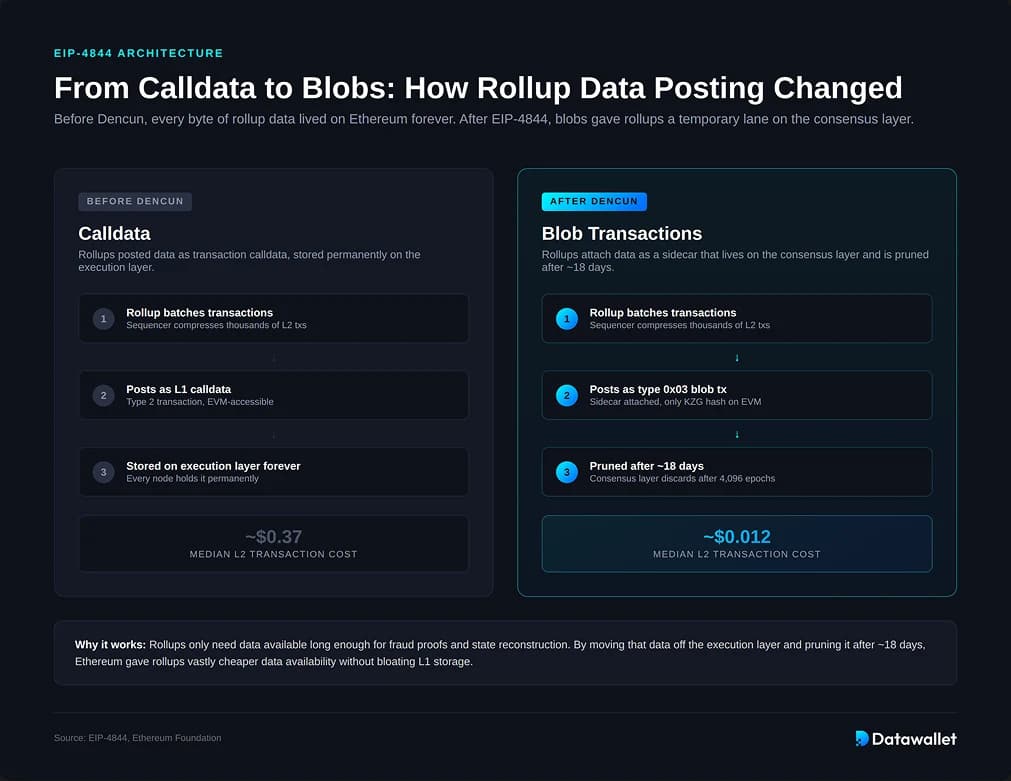
Fusaka's blob base fee linkage to L1 ensures a pricing floor, ending the zero-fee subsidy cycle. This bolsters Ethereum's revenue but spotlights Celestia's throughput edge. Data-intensive dApps, from AI models to video NFTs, favor Celestia's gigabyte blobs over Ethereum's 128KB limits. Post-Pectra spikes to 42,000 Gwei drove 15-20% of L2 traffic to Celestia, per on-chain metrics. With TIA at $0.5819 and 24h volume steady, traders eye Celestia blob pricing 2025 for asymmetry.
Practical play: sell Ethereum blob fee volatility while going long Celestia exposure. Straddles on blob gas futures capture Ethereum's teething pains, while Celestia calls premium from scarcity. Risk parity here demands 60/40 weighting: 60% Celestia for growth, 40% ETH shorts on overcapacity. Monitor phased ramps; December 17's jump to 10 blobs tests demand elasticity.
Capacity Clash: Ethereum vs Celestia Blockspace
Ethereum's 6/9 blobs today scale to 14/21 by January, slashing averages 50-70%. Celestia, unburdened by L1 calldata baggage, handles variable payloads without auctions. Late 2024 saw Celestia blob sizes x10, fueling data blob markets. Ethereum dominates small L2 posts; Celestia owns hyperscale DA. At current $0.5819, TIA undervalues this divergence.
| Metric | Ethereum (Post-Fusaka) | Celestia | Notes |
|---|---|---|---|
| Blob Capacity (Target/Max per Block) | 6/9 (→10/15 by Dec 17, 2025 →14/21 by Jan 7, 2026) | Flexible pay-per-use | ETH expansion to cut congestion 📈 |
| Avg Blob Size | 128 KB (fixed) | Surged nearly 10x late 2024 | Celestia suits large data needs |
| Fee Trend | Stabilized (linked to L1 base fee, no collapse/spikes) | TIA-denominated ($0.5819) | ETH expected 50-70% avg decrease |
| Pre-Fusaka Peak Fee | 42,000 Gwei (Oct 30, 2025) | N/A | High demand volatility |
| TIA 24h Market | N/A | +$0.0131 (+2.30%) High: $0.5891 Low: $0.5672 | Current as of 2025-12-07 |
Check why Celestia offers 3-4x cheaper blockspace for select use cases. My edge: Celestia's pay-as-you-go avoids Ethereum's congestion tax, drawing RWA tokenizers and ZK proofs.
Higher blob costs compress L2s but lock value in Ethereum DA; Celestia sidesteps via modularity. (Paraphrased from Fidelity)
Volatility traders, anchor to Celestia blockspace trends: TIA's 24h range $0.5672-$0.5891 signals consolidation before breakouts. Pair with blob fee dashboards; if Ethereum holds the floor sans spikes, Celestia volumes stabilize at 70-80% pre-Fusaka levels. Overbuild risk flips this: excess Ethereum capacity craters fees, repricing Celestia higher.
Risk-Managed Positions for Blob Traders
Build this portfolio: 40% TIA spot at $0.5819, 30% Celestia blob perps for leverage, 20% ETH blob inverse perps, 10% stables. Delta-neutral via options: buy Celestia Dec 2026 $1 calls, sell Ethereum gas straddles. Greeks matter: target 0.5 delta, 20% vega for fee pops. Exit on 14-blob activation if L2 migration accelerates.
Developers, benchmark Ethereum Fusaka blob fees against Celestia: post-upgrade averages could settle 20-30% below peaks, but Celestia's flexibility wins for 10MB and payloads. Blobspace Markets tracks this live; use our tools for real-time Celestia vs Ethereum blobs spreads.
Forward scan: Fusaka stabilizes Ethereum, but Celestia's niche fortifies TIA toward $1 and. Trade the transition, master the spread.



No comments yet. Be the first to share your thoughts!